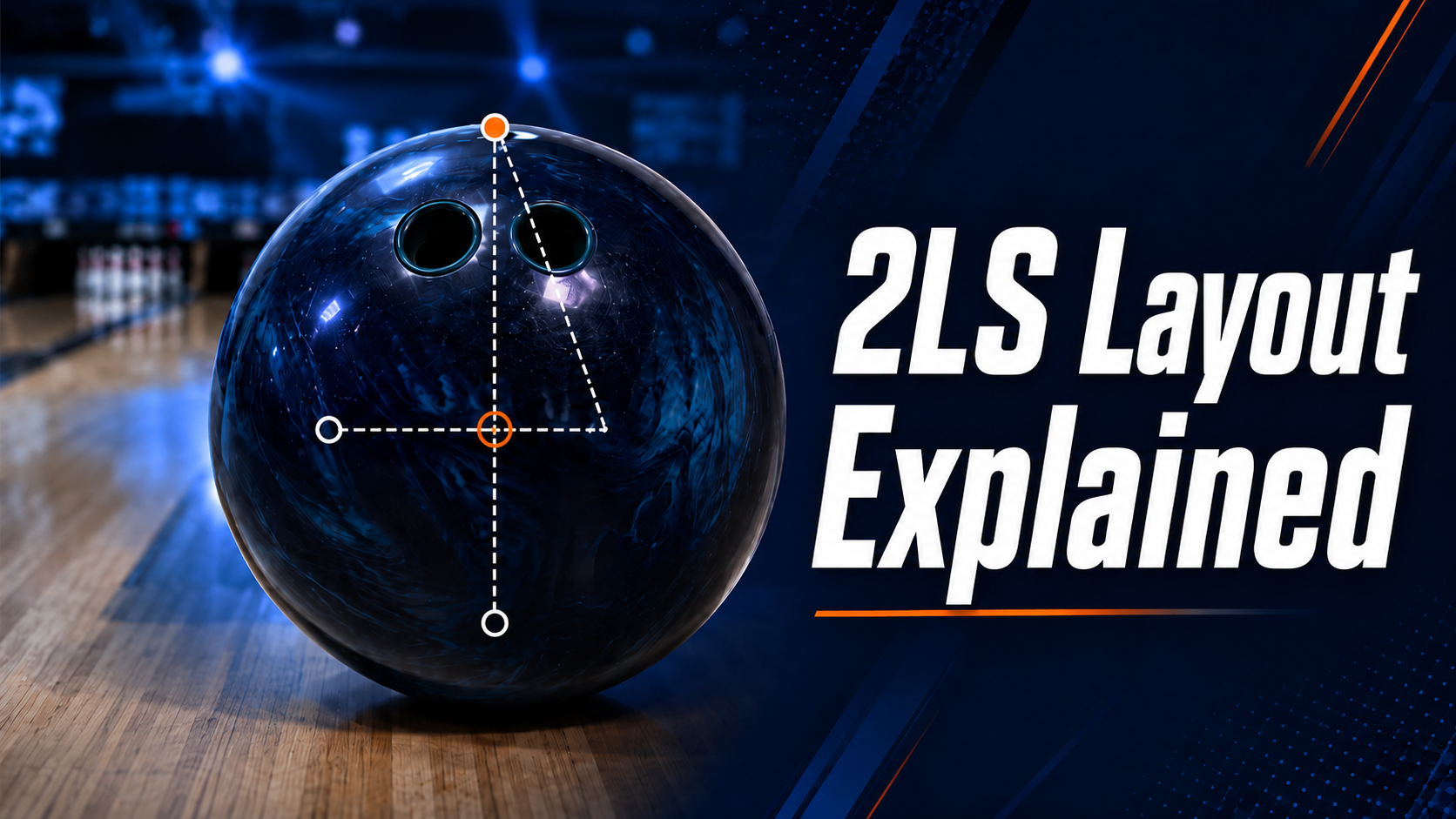
The 2LS layout is a bowling ball layout system designed for two-handed and thumbless bowlers.
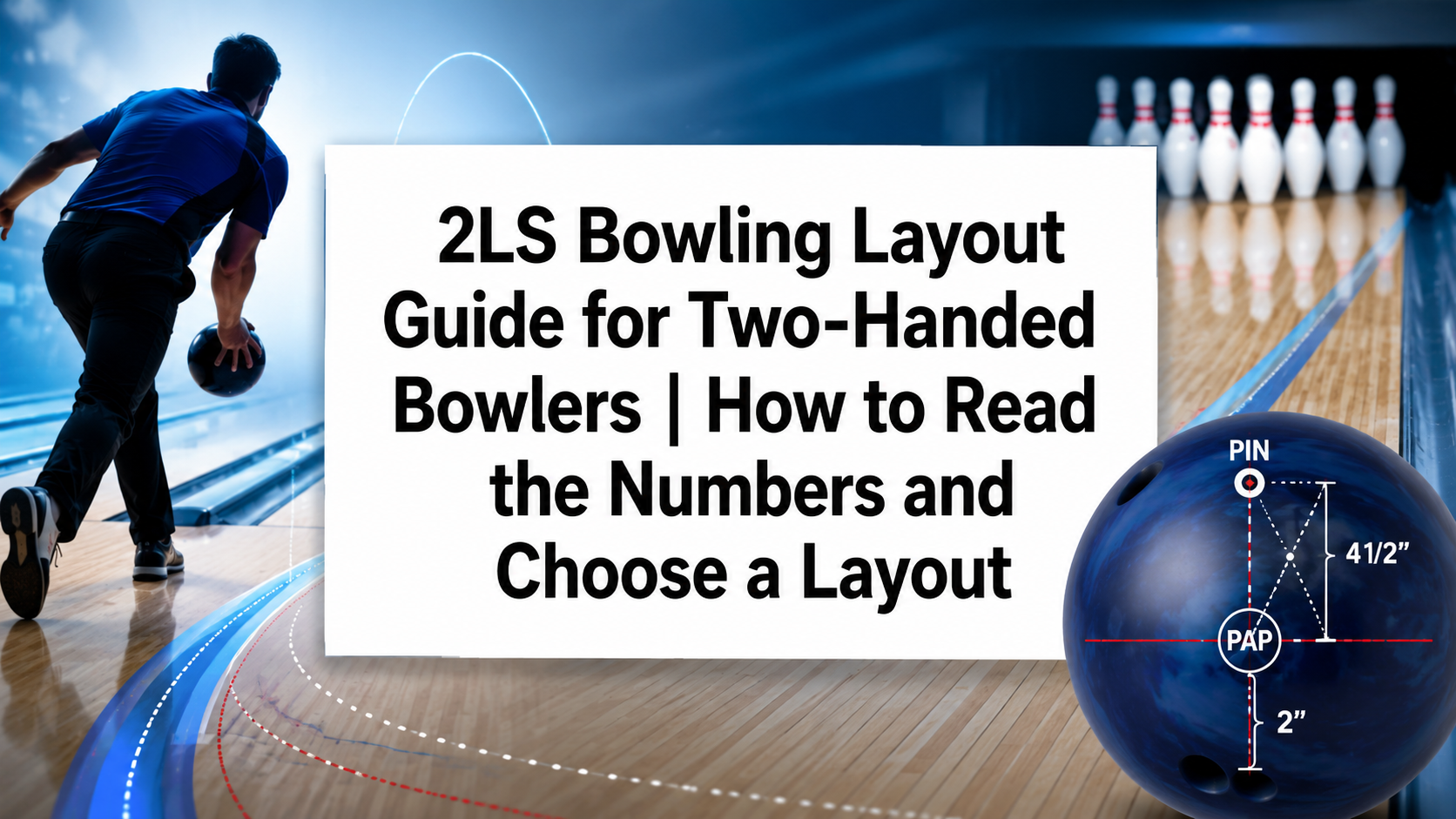
Unlike traditional layout systems that rely heavily on angles, such as Dual Angle or VAL-based layouts, the 2LS layout uses three distance-based measurements: Pin-to-PAP, PSA-to-PAP, and Pin-to-Center of Grip.
This makes 2LS especially useful for bowlers who do not use a thumb hole, because their release, PAP, rev rate, axis rotation, and track flare can behave differently from conventional one-handed bowlers.
In this guide, I’ll explain what the 2LS layout is, how the three numbers work, and how different 2LS layouts can affect bowling ball motion.
Official reference: Storm 2LS Poster Layout
- What Is the 2LS Layout?
- Why Two-Handed Bowlers Use 2LS
- The Three Measurements Used in 2LS
- 1. Pin-to-PAP Distance
- 2. PSA-to-PAP Distance
- 3. Pin-to-Center of Grip Distance
- How to Read a 2LS Layout
- 2LS Layout Examples for Two-Handed Bowlers
- 5 × 5 × 3
- 4 × 4 × 4
- 5.5 × 5 × 2
- 4.5 × 3.5 × 3.5
- How 2LS Affects Ball Motion
- Common Mistakes When Using 2LS
- Mistake 1: Choosing the Strongest Layout First
- Mistake 2: Ignoring the Third Number
- Mistake 3: Using 2LS Without Knowing Your PAP
- Mistake 4: Treating Every Two-Handed Bowler the Same
- How I Would Choose a Starting 2LS Layout
- 2LS and Japanese House Conditions
- 2LS vs Traditional Layout Systems
- Why 2LS Exists
- Final Thoughts
What Is the 2LS Layout?
2LS stands for Two-Hand Layout System.
It is a layout system created for bowlers who throw without using a thumb hole. That includes many two-handed bowlers and thumbless one-handed bowlers.
In a conventional thumb-in layout, the thumb hole, fingers, PAP, VAL, and layout angles all work together to describe how the core is positioned in relation to the bowler’s release.
For no-thumb bowlers, that situation changes.
The ball has no thumb hole. The grip center is different. The release can create a higher rev rate, different axis rotation, and a different track position. Because of that, traditional layout language does not always describe the ball motion clearly enough for two-handed bowlers.
2LS solves this by using distances instead of layout angles.
The three main numbers in a 2LS layout are:
・Pin-to-PAP distance
・PSA-to-PAP distance
・Pin-to-Center of Grip distance
A 2LS layout is usually written like this:
5 × 5 × 3
The first number is Pin-to-PAP.
The second number is PSA-to-PAP.
The third number is Pin-to-Center of Grip.
Why Two-Handed Bowlers Use 2LS
If you want to understand why 2LS exists in the first place, I also wrote a deeper article about the background of the system and why two-handed bowlers need a different layout approach.
Related article: Why 2LS Exists: The Real Reason Two-Handed Bowlers Need a Different Layout System
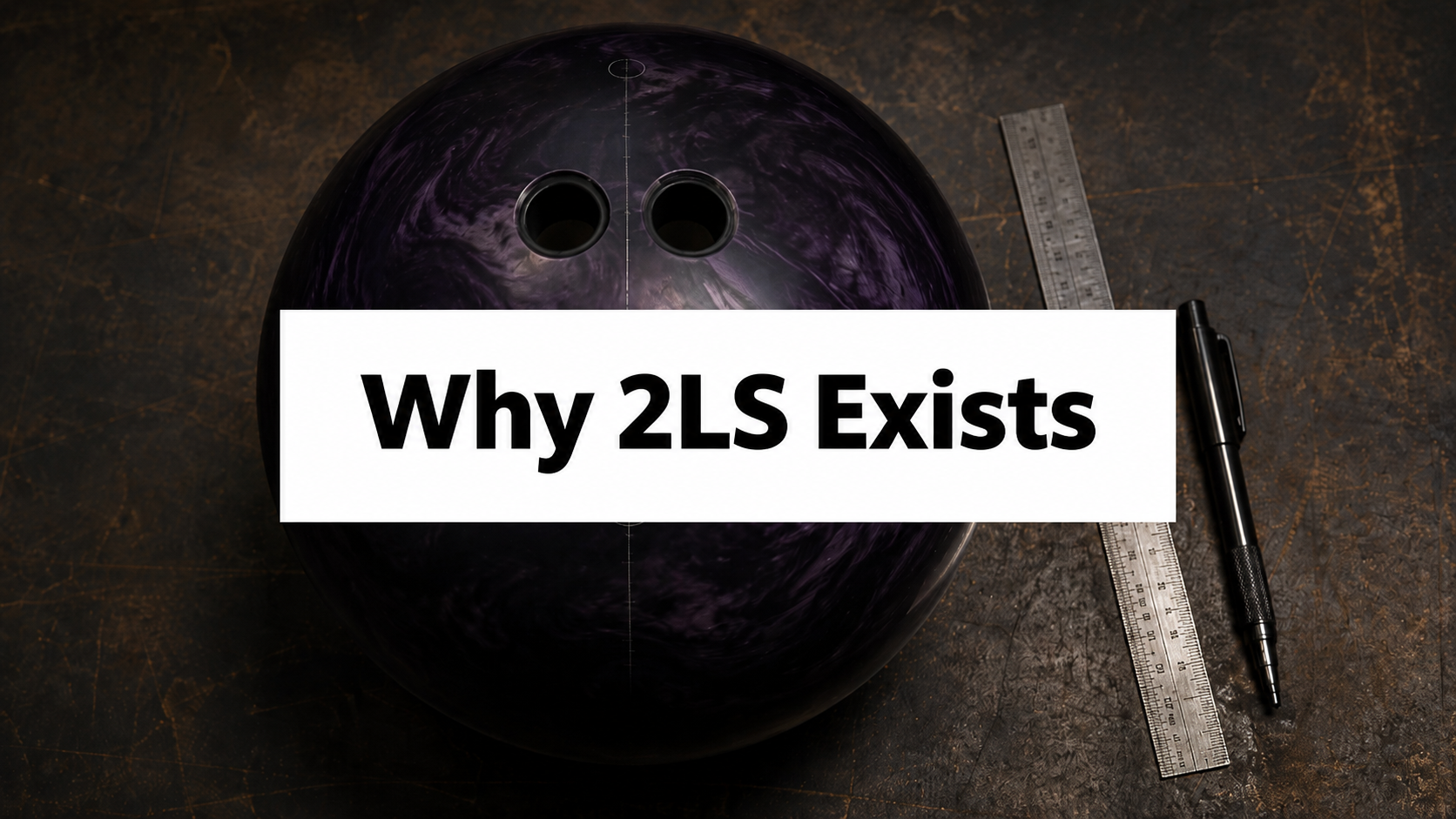

Two-handed bowlers often create a lot of rev rate. They also tend to have different axis tilt and axis rotation compared with traditional one-handed bowlers.
That does not mean every two-handed bowler needs a strong layout. In fact, many two-handed bowlers need the opposite.
Because the release already creates a lot of energy, a layout that is too strong can make the ball read too early, lose continuation, or become difficult to control at the breakpoint.
2LS is useful because it gives the bowler and pro shop a clearer way to adjust ball motion.
Instead of saying “pin up” or “pin down” in a vague way, 2LS lets you control:
・how early the ball reads
・how much flare potential is used
・how sharp or smooth the backend motion becomes
・how much post-drilled differential is created
・how the layout matches the bowler’s actual release
For two-handed bowlers, this is a big advantage.
The Three Measurements Used in 2LS
The 2LS layout uses three distance-based measurements.
Each number changes a different part of ball motion.
1. Pin-to-PAP Distance
The first number is Pin-to-PAP distance.
This distance affects how the core revs up and how the ball transitions from skid to hook.
As a general idea, a shorter Pin-to-PAP distance tends to make the ball read earlier and create a smoother breakpoint shape. A longer Pin-to-PAP distance tends to create more length and a later, more responsive motion downlane.
This does not mean shorter is always stronger or longer is always better. The result depends on the bowler, the ball, the surface, and the lane condition.
For two-handed bowlers, this number is very important because many two-handers already create a lot of rev rate. If the Pin-to-PAP distance is too short, the ball may start too early and lose energy before reaching the pins.
2. PSA-to-PAP Distance
The second number is PSA-to-PAP distance.
PSA means Preferred Spin Axis. On asymmetrical bowling balls, this measurement helps control how the mass bias is positioned in relation to the bowler’s PAP.
In simple terms, PSA-to-PAP affects the shape and direction of the backend motion.
A shorter PSA-to-PAP distance can make the ball respond earlier and more forward. A longer PSA-to-PAP distance can make the motion smoother and more controlled, depending on the rest of the layout.
This number is especially important for asymmetrical balls.
For symmetrical balls, the PSA is not as visible or dominant in the same way, so the second number may not influence motion as strongly as it does on an asymmetrical core.
3. Pin-to-Center of Grip Distance
The third number is Pin-to-Center of Grip distance.
This is one of the most important parts of 2LS.
The Center of Grip is based on the finger holes in a no-thumb layout. Since there is no thumb hole, the grip center is not the same as a traditional three-hole layout.
This distance affects the post-drilled dynamics of the ball. In practical terms, it can change the amount of differential used after drilling.
A shorter Pin-to-Center of Grip distance can reduce the post-drilled differential and create a smoother, more controlled motion.
A longer Pin-to-Center of Grip distance can increase the post-drilled differential and create more flare potential and stronger overall motion.
This is why the third number should not be ignored.
For two-handed bowlers, the third number can be the difference between a ball that reads smoothly and a ball that becomes too sharp or too unstable.
How to Read a 2LS Layout
Let’s use this example:
5 × 5 × 3
This means:
・5 inches from Pin to PAP
・5 inches from PSA to PAP
・3 inches from Pin to Center of Grip
This type of layout would generally be considered fairly clean and controllable, depending on the ball and surface.
Another example:
4 × 4 × 4
This means:
・4 inches from Pin to PAP
・4 inches from PSA to PAP
・4 inches from Pin to Center of Grip
This may create a stronger and more defined motion, but it can also become too much for some two-handed bowlers on typical house conditions.
The key point is that you should not choose a 2LS layout only because the numbers look strong.
A strong layout is not always the best layout.
For many two-handed bowlers, control is more valuable than maximum hook.
2LS Layout Examples for Two-Handed Bowlers
Here are some simple examples of how different 2LS layouts can be used.
5 × 5 × 3
This is a good example of a cleaner and more controllable layout.
It can be useful when you want the ball to get through the front part of the lane without reading too early.
For many two-handed bowlers, this type of layout can work well on house shots where the outside part of the lane has friction and the middle has more oil.
4 × 4 × 4
This layout can create a stronger and more defined motion.
It may be useful when you need the ball to pick up earlier or create more shape in the midlane.
However, for high-rev two-handed bowlers, it can sometimes be too strong if the lane is dry or the ball surface is too aggressive.
5.5 × 5 × 2
This type of layout can create more length with lower flare potential.
It may be useful when the lane is breaking down and you need the ball to stay cleaner through the front.
However, if there is not enough friction downlane, the ball may miss the breakpoint or respond too late.
4.5 × 3.5 × 3.5
This type of layout can create an earlier and smoother motion.
It may be useful when you want the ball to read the lane sooner and avoid a sharp overreaction downlane.
For two-handed bowlers who struggle with the ball jumping off the dry boards, a smoother layout can be easier to control.
How 2LS Affects Ball Motion
A 2LS layout does not work by itself.
The final ball motion depends on:
・the bowler’s release
・PAP
・rev rate
・ball speed
・axis rotation
・axis tilt
・coverstock
・surface
・core type
・lane condition
This is why copying a professional bowler’s layout is not always a good idea.
Two bowlers can use the same 2LS numbers and see different reactions.
For example, a 5 × 5 × 3 layout may look smooth for one bowler but too late for another. A 4 × 4 × 4 layout may be useful for one bowler but too strong for someone with higher revs or slower ball speed.
The layout is only one part of the total ball reaction.
Common Mistakes When Using 2LS
Many two-handed bowlers make the same mistakes when choosing a 2LS layout.
Mistake 1: Choosing the Strongest Layout First
A lot of two-handed bowlers want more hook.
But more hook does not always mean better motion.
If the ball reads too early, it can lose energy before it reaches the pins. The result may be weak 10 pins, flat hits, or a ball that looks strong in the midlane but does not continue through the deck.
For many two-handed bowlers, a balanced layout is a better starting point than the strongest layout.
Mistake 2: Ignoring the Third Number
The third number, Pin-to-Center of Grip, is very important in 2LS.
Some bowlers focus only on Pin-to-PAP and PSA-to-PAP, but the third number can change the post-drilled differential and overall motion.
If the third number is not chosen carefully, the ball may become too smooth, too sharp, or simply different from what the bowler expected.
Mistake 3: Using 2LS Without Knowing Your PAP
2LS is based on distances from the bowler’s PAP.
If the PAP is wrong, the layout will not mean what you think it means.
This is especially important for two-handed bowlers because their PAP can be different from traditional one-handed bowlers.
If possible, measure your PAP with help from a pro shop instead of guessing.
Mistake 4: Treating Every Two-Handed Bowler the Same
Not all two-handed bowlers have the same release.
Some have high speed and high revs.
Some have lower speed and more axis rotation.
Some are very up the back of the ball.
Some create a lot of side rotation.
Some track high, while others track lower.
Because of this, the same layout can produce very different results.
2LS is useful because it gives you a language to adjust the layout to your own game.
How I Would Choose a Starting 2LS Layout
If you are new to 2LS, I would not start with the most extreme layout.
For many two-handed bowlers, a balanced layout is easier to understand.
A practical starting point might be around:
5 × 5 × 3
or
4.5 × 4.5 × 3.5
These are not magic numbers. They are only examples.
The goal is to start with a layout that is readable, controllable, and easy to compare with future balls.
Once you understand how that ball reacts, you can adjust the next layout.
If the ball reads too early, you may need more length.
If the ball is too slow to respond, you may need a different Pin-to-PAP distance or surface adjustment.
If the ball flares too much or too little, the Pin-to-Center of Grip distance may need to be reconsidered.
This is how 2LS becomes useful: not as a single perfect layout, but as a system for comparing and adjusting ball motion.
2LS and Japanese House Conditions
Many Japanese house conditions can be different from what overseas bowlers imagine.
Depending on the center, the lanes may feel wet-dry, cliffed, or very sensitive to speed and angle. For two-handed bowlers, this can make strong layouts difficult to control.
If the ball jumps too hard when it touches friction, a smoother 2LS layout may be better than an aggressive one.
If the ball skids too far and never reads the midlane, you may need either more surface, a stronger ball, or a layout that helps the ball transition earlier.
In Japan, many recreational bowlers also start with house balls or campaign balls before buying stronger reactive equipment. That makes layout choice even more important when moving into a real performance ball.
A strong two-handed release does not always need the strongest drilling.
Sometimes, the better choice is a layout that gives you control, blend, and predictable motion.
Related article: How Two-Handed Bowlers Should Adjust to Japanese Bowling Lane Conditions
2LS vs Traditional Layout Systems
2LS is not necessarily better than every other layout system.
It is simply a better fit for a certain type of bowler.
Traditional layout systems can still work well, especially when the bowler uses a thumb hole and has a conventional release.
But for two-handed and thumbless bowlers, 2LS gives a more direct way to describe the relationship between the core and the no-thumb grip.
That is the main value of 2LS.
It helps translate a two-handed bowler’s release into layout numbers that can be repeated, compared, and adjusted.
Why 2LS Exists
The biggest reason 2LS exists is that two-handed bowlers do not fit neatly into older layout assumptions.
The grip is different.
The release is different.
The axis point can be different.
The way the ball flares after drilling can be different.
That does not mean two-handed bowlers need special treatment in every situation. But it does mean their layout system should match how they actually release the ball.
If you want to understand the background of the system in more detail, I also wrote a deeper article about why 2LS exists.
Related article: Why 2LS Exists: The Real Reason Two-Handed Bowlers Need a Different Layout System
Final Thoughts
The 2LS layout is a practical system for two-handed and thumbless bowlers.
Instead of relying on vague terms like pin up or pin down, it uses three clear measurements:
・Pin-to-PAP
・PSA-to-PAP
・Pin-to-Center of Grip
These numbers help control when the ball reads, how it transitions, and how much post-drilled motion the ball can create.
For two-handed bowlers, the most important point is not to chase the strongest layout. The goal is to find a layout that matches your release, ball speed, rev rate, lane condition, and purpose for that ball.
A good 2LS layout should make the ball easier to read, not harder to control.
If you are drilling a new ball, talk with a pro shop that understands two-handed and no-thumb layouts. Use 2LS as a tool to describe what you want the ball to do, and then compare each new ball reaction with the layout numbers you used.
That is how 2LS becomes useful over time.
コメント