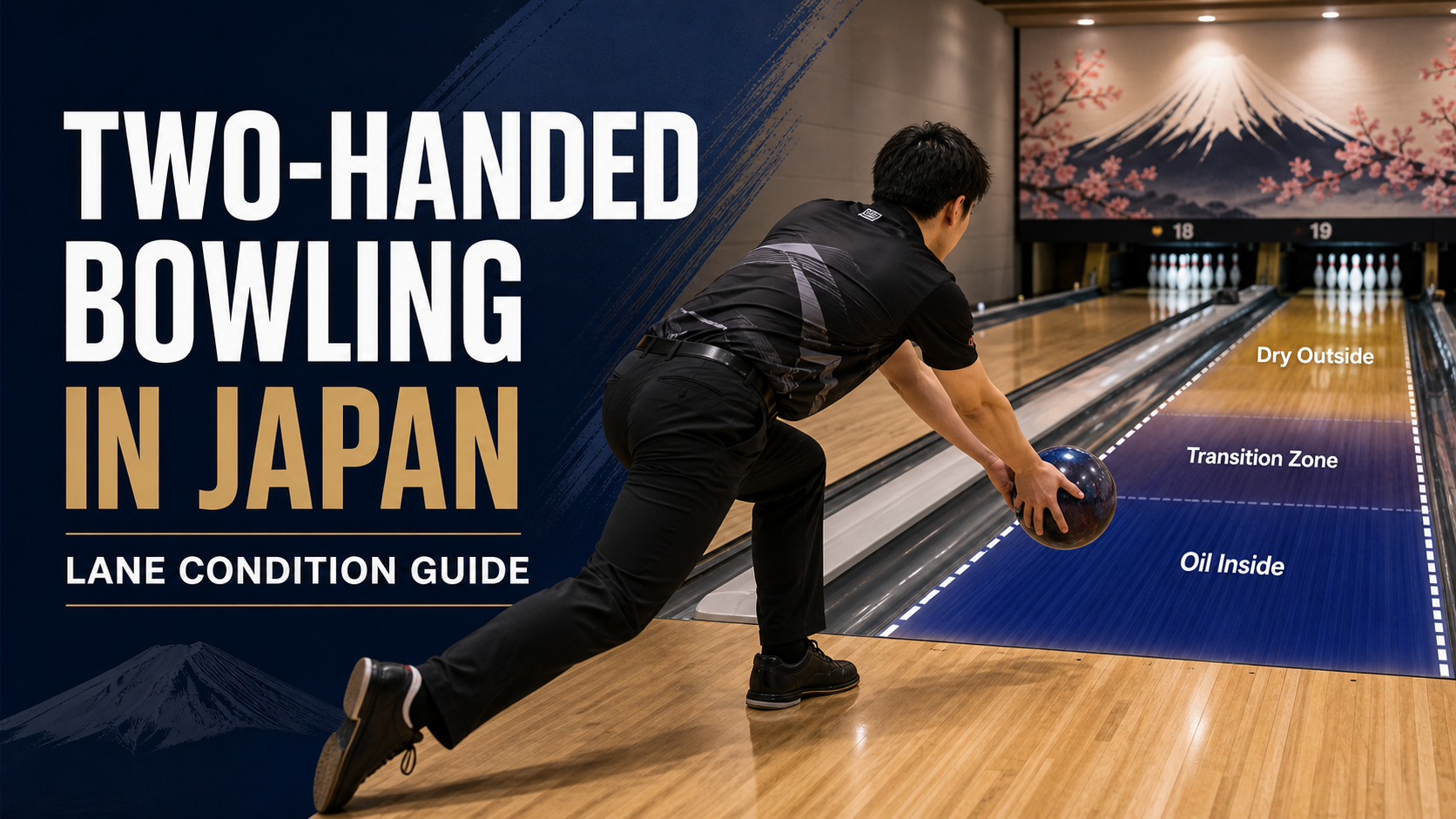
Two-handed bowling has become much more common in Japan.
Walk into a competitive bowling center today, and you will often see multiple two-handed bowlers on the lanes. The style is no longer unusual. It is not treated as a strange or experimental way to bowl anymore.
But if you are a two-handed bowler from overseas, or if you have mostly learned from watching PBA tournaments on YouTube, competing in Japan can feel very different from what you expect.
Japanese bowling centers can create a unique challenge for high-rev bowlers.
It is not simply about throwing harder, creating more hook, or using the strongest ball in your bag. In many cases, the key is learning how to manage fast transition, worn lane surfaces, and sharper friction changes.
I have bowled two-handed in Japanese competitive environments for years. This is what I have learned.
- Japan’s bowling environment can feel different
- The transition problem for high-rev bowlers
- Stronger surface is not always the answer
- What I check before competing in Japan
- 1. Lane age and surface condition
- 2. Who is bowling on my pair
- 3. Where the friction starts
- 4. How the ball goes through the pins
- 5. Whether I should change early
- The biggest mindset shift
- Practical adjustment order for two-handed bowlers
- Not every Japanese bowling center plays this way
- Final thoughts
- Related articles
Japan’s bowling environment can feel different
Japan had a massive bowling boom in the early 1970s. Because of that history, many bowling centers still carry the legacy of that era.
Some centers are modern and well maintained. Others have older lane beds, worn track areas, or lane surfaces that do not play like the clean synthetic conditions many overseas bowlers imagine.
This does not mean Japanese bowling centers are bad.
It means that the lane surface can sometimes be more sensitive than expected.
On older or more worn lanes, oil may not hold or transition the way it does on newer surfaces. A condition that looks playable at the start of practice can change quickly once multiple bowlers start throwing shots in the same area.
For a two-handed bowler, this matters a lot.
Two-handed bowling naturally creates a higher rev rate. On fresh and consistent oil, that can be a major advantage. But on lanes where friction appears quickly or unevenly, that same rev rate can become difficult to control.
The ball may read the lane too early.
It may jump at the breakpoint.
It may look great for one shot and completely overreact on the next.
That is one of the biggest challenges of bowling two-handed in Japan.
The transition problem for high-rev bowlers
Many competitive bowlers in Japan use higher ball speed to control ball motion.
You will often see players who keep the ball in play by throwing fast, staying firm with their speed, and using the oil in the middle of the lane to hold the shot. This style can be very effective, especially on typical house conditions.
But when many speed-dominant bowlers play the same part of the lane, the condition can change quickly.
The oil can break down in the track area. Carrydown can appear farther downlane. The contrast between early friction and delayed skid can become much sharper.
For two-handed bowlers, this creates a specific problem.
A high-rev release reads oil-to-friction changes strongly. If the lane has a sharp wet-dry shape, the ball may skid too long in the oil and then react too violently when it finds friction.
That reaction can look powerful, but it is not always useful.
A big move at the breakpoint can create inconsistent entry angles. It can also make carry unpredictable. One shot may strike flush, while the next leaves a flat 10, a 4-pin, a 9-pin, or even a split from what felt like a similar release.
When this happens, many two-handed bowlers make the same mistake.
They try to throw harder.
They move deeper.
They open the lane more.
Sometimes that works. But in many Japanese tournament conditions, it can make the reaction even harder to control. The ball sees the friction later, changes direction more sharply, and the margin for error becomes smaller.
Stronger surface is not always the answer
This took me a long time to understand.
When a lane feels difficult, many bowlers immediately think they need a stronger ball or more surface.
Sometimes that is correct.
But in Japanese competitive environments, especially on older or quickly transitioning conditions, a strong aggressive surface can be too much for a two-handed bowler.
The ball may start reading too early in the front part of the lane. It may lose energy before it reaches the pins. It may look like it is hooking, but the hit becomes weak.
That is one of the most misleading parts of bowling.
More hook does not always mean more power.
More surface does not always mean more control.
For high-rev two-handed bowlers, a cleaner cover or a less aggressive surface can often be more useful. A ball that gets through the front part of the lane cleanly can save energy better. It may create a smoother and more predictable shape downlane.
In many Japanese tournament conditions, I find myself moving toward less surface rather than more.
That does not mean polished balls are always better. It depends on the lane, the oil volume, and your speed-rev balance.
But the important point is this:
Do not assume that a stronger ball will solve every problem.
If your ball is reading too early, jumping off friction, or losing energy at the pins, you may need a cleaner reaction, not a stronger one.
What I check before competing in Japan
Before I throw my first serious shot in a Japanese tournament, I try to check a few things.
1. Lane age and surface condition
I look at the track area.
If the boards or surface look worn, I expect the lane to transition faster than the pattern sheet suggests. Even if the oil pattern looks medium on paper, it may play shorter or drier once the block starts.
This is especially important for two-handed bowlers because high rev rates expose friction quickly.
2. Who is bowling on my pair
I pay attention to the other bowlers in my squad.
If many players are throwing fast through the same zone, the lane may develop a sharp wet-dry shape. The track area can break down, while oil remains in the middle or gets carried farther downlane.
That kind of transition can make a high-rev ball reaction very sensitive.
3. Where the friction starts
I want to know where the ball first starts reading the lane.
If it starts too early, I may need to use a cleaner ball, move my eyes, or adjust my speed. If it skids too far and jumps late, I may need a smoother shape or a different launch angle.
The key is not only watching how much the ball hooks.
The key is watching when it hooks.
4. How the ball goes through the pins
This is one of the most important points.
A ball can look impressive and still hit weak.
If the ball makes a big move but deflects at the pocket, it has probably used too much energy before impact. If the ball goes through the pins too flat, the shape may be too smooth or too forward.
For two-handed bowlers, carry is not only about hook.
It is about entry angle, energy retention, and predictable motion.
5. Whether I should change early
In Japan, I try not to wait too long before making a ball change.
If the reaction is already too sharp in practice, it will probably become worse during competition. If the ball is reading too early, I do not want to spend two games proving what I already saw in warm-up.
Early adjustment is often better than late correction.
The biggest mindset shift
The biggest mistake I see from two-handed bowlers, including myself in the past, is using a power-first mindset.
Two-handed bowling creates power naturally.
That is one of its biggest strengths.
But in many Japanese tournament conditions, raw power is not enough. In fact, too much shape can become a problem. If the lane is transitioning quickly or the friction is uneven, a big hook can make the pocket harder to control.
The better mindset is this:
Use your rev rate as a precision tool, not a weapon.
Your rev rate gives you options. It allows you to create angle. It allows you to shape the ball. It allows you to use balls and lines that some other players cannot use.
But if you chase maximum hook on every shot, you may lose the most important thing in competition.
Repeatability.
The bowlers who perform well in Japan are often the ones who read transition quickly, make ball changes before the reaction becomes unmanageable, and prioritize consistent pocket entry over maximum backend motion.
Practical adjustment order for two-handed bowlers
When I struggle on Japanese conditions, I usually think in this order.
First, I check whether the ball is reading too early.
If it is, I consider using a cleaner ball, reducing surface, moving my target, or increasing speed slightly.
Second, I check whether the ball is skidding too far.
If it is, I may need more surface, a stronger cover, or a line that lets the ball see friction sooner.
Third, I check whether the breakpoint is too sharp.
If the ball is jumping too hard off the dry, I may need a smoother ball shape, a more controlled release, or a line that avoids the steepest part of the wet-dry area.
Fourth, I check carry.
If the ball is hitting weak, I do not simply assume I need more hook. I ask whether the ball is using energy too early or entering the pocket at the wrong angle.
This order keeps me from making emotional adjustments.
It is easy for a two-handed bowler to think, “I need to hook it more.”
In Japan, the better question is often:
“How can I make the ball shape more predictable?”
Not every Japanese bowling center plays this way
Of course, not every bowling center in Japan plays the same.
Some newer centers with well-maintained synthetic lanes can feel very clean and predictable. Some tournament conditions are well controlled. Some house shots are very playable for two-handed bowlers.
So this is not a rule for every lane in Japan.
It is a pattern I have noticed from competing across different Japanese environments, especially in centers where the lanes transition quickly or the track area shows wear.
If you are bowling in Japan for the first time, do not assume the lanes will always be extremely dry, extremely difficult, or completely different from what you know.
But be ready for fast transition.
Be ready for friction that appears earlier than expected.
Be ready for a condition where the strongest ball in your bag is not always the best choice.
Final thoughts
If you are a two-handed bowler planning to compete in Japan, start with surface management and transition control.
Do not build your strategy around maximum hook.
Watch the lane surface. Watch the other bowlers. Watch how quickly the track area changes. Pay attention to whether your ball is storing energy or spending it too early.
In many Japanese competitive environments, the best two-handed bowling is not the most powerful bowling.
It is the most adaptable bowling.
Your rev rate is a major advantage, but only if you control how and when the ball uses it.
That is the real challenge of competing as a two-handed bowler in Japan.
Related articles
If you read Japanese, these articles may also help:
両手投げとオイルパターンの考え方
https://twohandbowling.com/archives/912.html
レーンアジャストの考え方
https://twohandbowling.com/archives/37.html
コメント