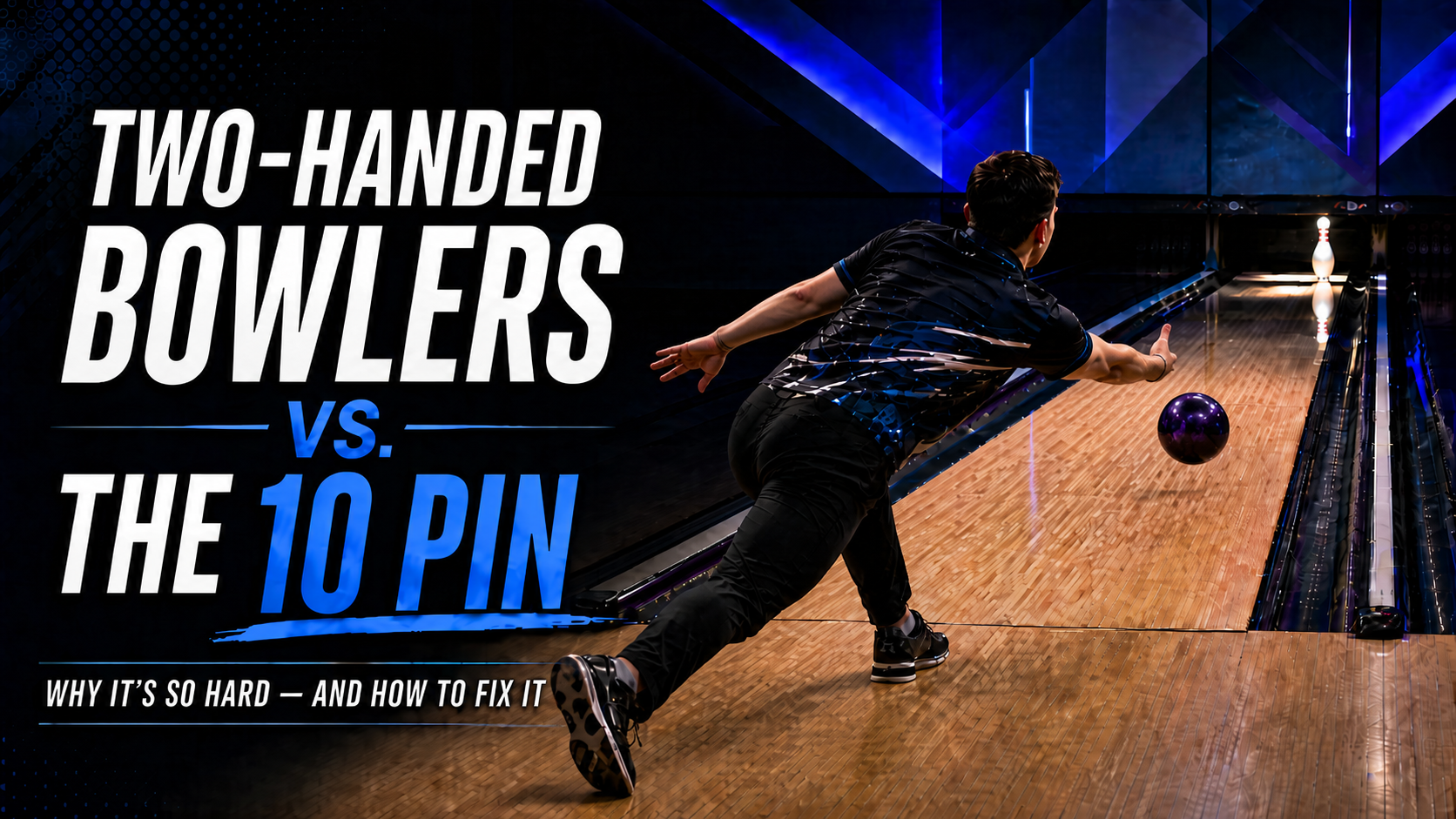
If you bowl two-handed as a right-hander, you already know the feeling. You’re having a great game, strike after strike — and then the 10 pin shows up. Alone. Mocking you from the far right corner.
You step up, make your delivery, and the ball hooks away as if it’s trying to avoid the pin entirely. Or worse, it barely clips the pin or misses it at a bad angle.
I’ve been bowling two-handed for over 10 years. The 10 pin has been my enemy for most of that time. This article is everything I wish someone had told me earlier.
Why the 10 Pin Is Structurally Harder for Two-Handed Bowlers
One-handed bowlers struggle with the 10 pin too — but for different reasons. For two-handed bowlers, the problem is built into the style itself.
The two-handed delivery naturally generates a lot of axis rotation. That’s what gives us our rev rate and hook potential. It’s what makes the style so powerful on the first ball.
But on a spare shot at the 10 pin, that same axis rotation becomes the enemy. The ball hooks away from the pin before it even gets there. And the more you try to “aim,” the more tension you introduce — which often makes the rotation problem worse.
This is the root cause that most articles don’t address: the 10 pin problem for two-handed bowlers is a rotation problem, not just an accuracy problem.
The Most Common Mistake: Too Much Axis Rotation
When two-handed bowlers miss the 10 pin, it often comes from the same mistake: creating too much axis rotation at the moment of release.
Here’s what happens in slow motion:
- You approach the 10 pin and subconsciously tighten your delivery
- Your left foot stops too abruptly at the foul line
- The sudden stop causes your body to snap, which adds unwanted axis rotation
- The ball hooks before it reaches the 10 pin and misses to the left
The harder you try to be accurate, the more you stop your slide — and the more axis rotation you accidentally create. It becomes a cycle.
I spent years trying to “aim more carefully,” but it never fixed the problem. The issue wasn’t my aim. It was my rotation.
Three Things That Actually Fixed It
1. Don’t Push Your Right Shoulder Forward
This was the biggest fix for me. When I tried to “point” at the 10 pin, I unconsciously pushed my right shoulder forward. That shoulder movement directly translated into extra axis rotation on the ball.
The fix is to keep your shoulders square to the target. Don’t let your right shoulder chase the pin. Don’t reach. Stay compact through the release.
It feels unnatural at first — almost like you’re not aiming at the pin. But your ball path will straighten out almost immediately.
2. Don’t Stop Your Left Foot Too Hard
A clean, controlled slide matters even more on spare shots than on strike shots. If your left foot plants too hard and stops suddenly, your upper body has nowhere to go — so it twists, adding rotation you don’t want.
Let the slide happen naturally. A slightly softer stop allows your delivery to stay smooth. Think of it as absorbing the shot rather than stopping for it.
3. Consciously Focus on Forward Roll
This is the mental cue that brought everything together for me. Instead of thinking only about where the ball goes, focus on the type of roll you’re creating.
On a 10-pin spare, I now consciously think: “forward roll only.” Imagine the ball rolling end over end, like a tire, instead of turning it like a hook shot. This mental shift naturally reduces axis rotation without forcing you to think about your mechanics directly.
It sounds simple. It works better than anything else I’ve tried.
Equipment Adjustments That Help
Sometimes the mechanical fixes above aren’t enough on their own. These equipment tweaks can support your spare game:
Slide Sole Adjustment
If your left foot grips the approach too hard and causes an abrupt stop, try a slightly more slippery slide sole on your bowling shoe. A smoother slide gives your body more time to complete the delivery without snapping. Small change, noticeable difference.
Surface Adjustment on Your Spare Ball
If your spare ball is skidding too long or reacting too sharply at the end, a small surface adjustment can help. A slightly duller surface can make the ball pick up friction earlier and more predictably, which may reduce sudden late movement.
This is not necessary for everyone. But if your spare ball feels too jumpy downlane, changing the surface slightly can turn a dramatic miss into a more manageable reaction.
Thumbless Drilling
Some two-handed bowlers use a spare ball without a thumb hole and adjust the finger pitches to encourage a more forward-oriented release. Experimenting with your spare ball’s drilling layout can fundamentally change how the ball exits your hand — and reduce unwanted rotation at the source.
What I Wish Someone Had Told Me Earlier
After more than 10 years of two-handed bowling, here’s the honest summary:
The 10 pin got easier the moment I stopped trying to aim harder and started focusing on rotation.
Two things changed my spare game permanently:
- Keeping my right shoulder square instead of pushing it forward
- Thinking “forward roll” instead of “hook”
Everything else — foot slide, equipment, approach angle — supports those two things. But without the rotation fix, nothing else matters much.
If you’re a two-handed bowler struggling with the 10 pin, start there. It’s simpler than it looks. And yes, it will still make you nervous every time — but at least you’ll know what to do about it.
Have a different approach to the 10 pin as a two-handed bowler? I’d love to hear what works for you. Leave a comment below.
コメント